
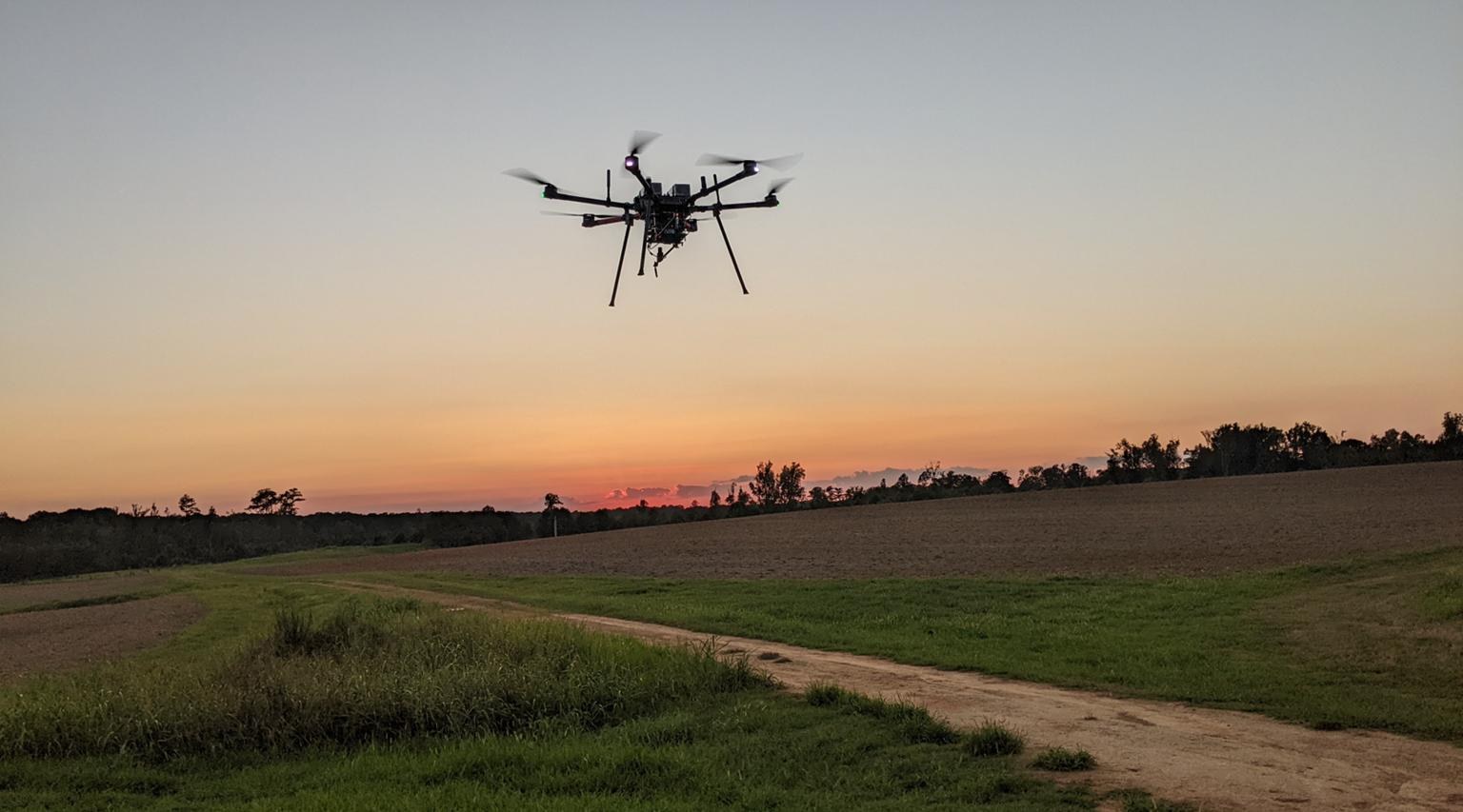
The AORA Student Challenge
AERPAW’s third student challenge — and its first fully open-ended one. Define your own concept at the intersection of autonomous drones and next-generation wireless, and fly it on a real aerial wireless testbed.
- Announcement: GRCon, September 2026
- Format: Open-ended, two-stage (Digital Twin, then testbed)
- Team size: Up to 4 students + faculty advisor
- Default spectrum: 3.3–3.45 GHz
- Registration deadline: December 31, 2026
AORA — AERPAW Open Research on Autonomy — is a fully open-ended student competition at the intersection of autonomous uncrewed aerial systems (UAS) and 5G/6G wireless. Rather than a single shared problem, each team proposes and builds its own concept, developed first in AERPAW’s Digital Twin and, for finalist teams, deployed on AERPAW’s real aerial wireless testbed.
This page describes AORA’s scope, platform requirements, evaluation process, timeline, and rules. It will be updated as the competition approaches its official announcement at GRCon in September 2026 — details marked “tentative” below are subject to change. Teams can register until December 31, 2026 — register here.
Concept and Scope
AORA does not assign a fixed mission. Instead, each team defines its own research concept, provided it combines autonomous UAS operation with a 5G/6G wireless or sensing capability, and uses a canonical experiment format built on one of the following frameworks:
- GNU Radio — a free, open-source SDR framework
- srsRAN (LTE) and OCUDU (5G) — a full 4G/5G RAN stack
- OpenAirInterface (OAI) — an open-source cellular stack
Teams may build on AERPAW’s existing sample experiments as a starting point, or develop their own software from scratch. Example concept areas include:
- OTFS waveform design
- RF sensing
- AI-RAN and machine-learning-driven radio resource management
- Spectrum sharing and dynamic spectrum access
- Agentic UAVs and autonomous mission planning
- …or any other 5G/6G concept combined meaningfully with autonomous UAS operation
These are illustrative only — AORA does not require any specific use case. Other examples at the intersection of wireless and autonomy include sensor data collection, counter-UAS, federated learning and over-the-air computation, UAV-to-UAV communications, search and rescue, natural disaster response, beamforming and tracking, and UAVs as cellular relays.
Platform and Software
Every AORA development takes place in AERPAW’s Digital Twin — a high-fidelity, software-in-the-loop simulation of the real testbed, running the same vehicle and radio software teams will later fly for real. Finalist teams then run that same software on AERPAW’s physical towers and drones, unmodified.
GNU Radio
Sample experiments: OFDM Tx/Rx, channel sounding, LoRa PHY.
srsRAN (LTE) and OCUDU (5G)
Sample experiments: multi-node LTE, LTE MIMO, single-node 5G SA.
OpenAirInterface (OAI)
Sample experiments: two-node LTE, 5G Standalone.
AERPAW’s User Manual maintains a growing sample-experiments repository — a starting point, not a limit:
- Radio software — srsRAN (SE1–SE4, SE6), OAI (OE1–OE2), GNU Radio (GE1–GE3)
- Vehicle control — preplanned trajectory, GPS logger, multi-vehicle coordination, autonomous vehicle control
- Traffic generation — Ping, iPerf, MGEN
- End-to-end samples — UAV LTE eNB serving ground UEs, channel sounder & I/Q post-processing, TDOA-based UAV localization, OAI 5G with a flying UAV
Learn more about the Digital Twin development environment, validated in peer-reviewed research including IEEE Communications Magazine (2025), IEEE ICC (2025), IEEE VTC (2024), and Elsevier Computer Communications (2021).
Frequency Band
| Use | Band |
|---|---|
| SDR experiments | 3.3 – 3.45 GHz |
| Ericsson 5G experiments | 3.3 – 3.45 GHz |
| Ericsson LTE experiments | 1.7 GHz (uplink) / 2.1 GHz (downlink) |
Need a different band? Other frequency bands may be available on a case-by-case basis, but must be coordinated in advance with the AERPAW team.
AERPAW operates under its own FCC Innovation Zone (approved 2021, FCC Call Sign WK2XQH) and follows FAA Part 107 rules for flight operations — line-of-sight, under 55 lbs, less than 100 mph, and below 400 ft. For safety, the fastest UAV speed AERPAW allows is 15 m/s. Read the full FCC & FAA regulations.
Platform Rules at a Glance
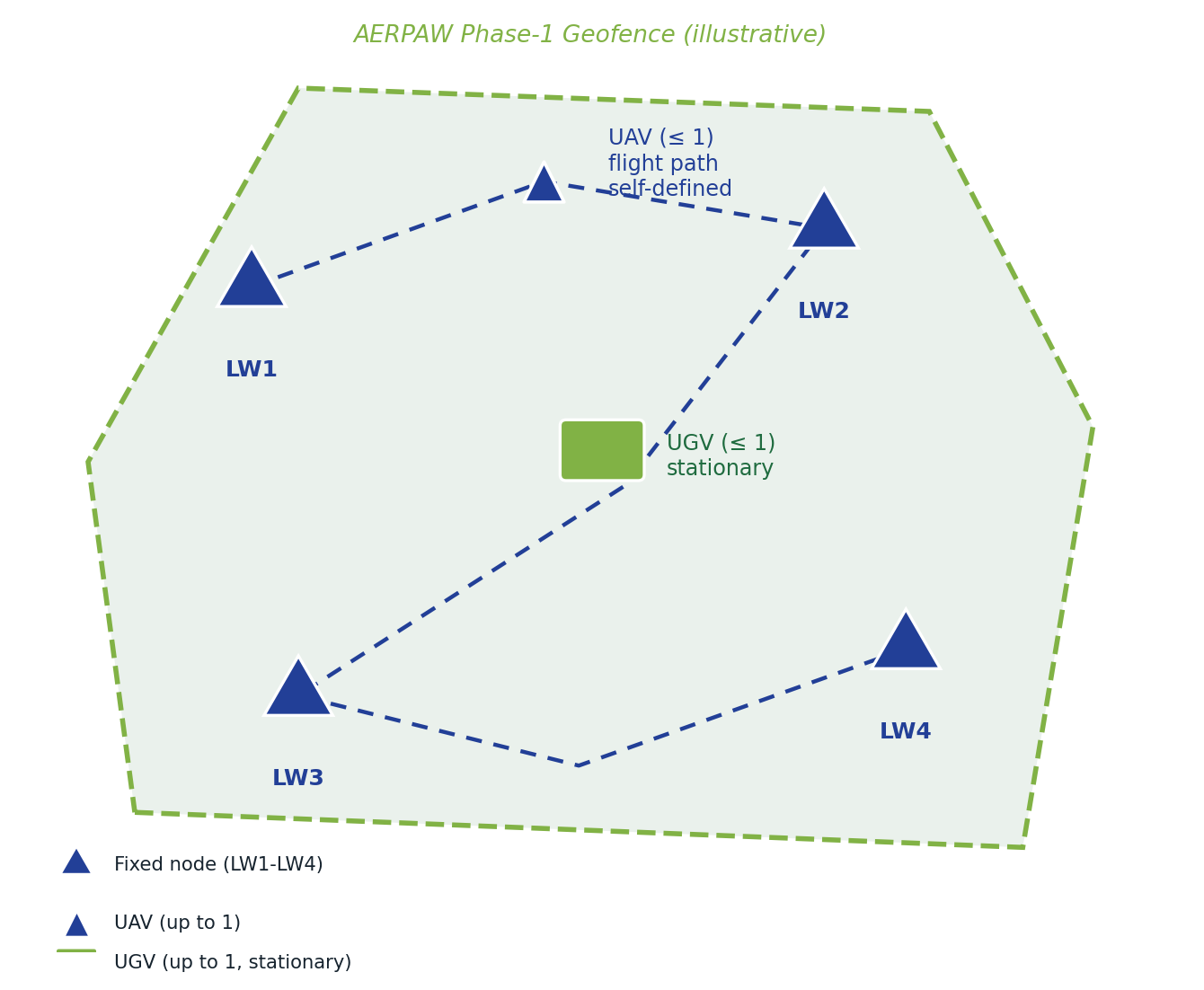
- Fixed nodesUp to 4 (LW1 – LW4)
- UAVUp to 1 — the Large AERPAW Multicopter (LAM), self-defined flight path
- UGVUp to 1, operated in a stationary configuration
- Flight areaPhase-1 geofence only — no operation outside this boundary is permitted
- Development environmentAERPAW Digital Twin required for all development
- Maximum UAV speed15 m/s, enforced for safety
How It Works: A Two-Stage Competition
- Register and form your team
- Develop in AERPAW’s Digital Twin
- Submit your software, plus a 3-page report describing your concept and representative results from the Digital Twin
- Committee Evaluation #1 Digital Twin results are scored by the review committee
- Testbed deployment Top 6 finalist teams run their unmodified software on AERPAW’s physical towers and drones
- Results returned to teams, and 6-page report submitted by teams
- Committee Evaluation #2 and winners announced
How You’ll Be Judged
A five-member review committee — drawn from both wireless communications and UAS domains — scores every submission. Digital Twin results are scored first; testbed performance is scored for finalists in Stage 2.
Novelty
Of the concept, and how well it integrates autonomous UAS with wireless technology.
Stability & performance
Of the developed code, in AERPAW’s Digital Twin.
Reproducibility
Of the submitted results.
Clarity of the reports
The 3-page Digital Twin report, plus a 6-page final report from finalists.
Potential impact
Of the project’s findings.
Timeline
| Milestone | Target Date |
|---|---|
| Announcement | GRCon, September 2026 |
| Registration | Open now — through December 31, 2026 |
| Digital Twin and 3-page report submissions due | April 2027 (tentative) |
| Committee Evaluation #1 | May 2027 (tentative) |
| Testbed deployment, data return & 6-page report due | June – July 2027 (tentative) |
| Winners announced | August 2027 (tentative) |
Development in AERPAW’s Digital Twin can begin as soon as your team registers, well before the registration window formally closes. Exact 2027 milestone dates will be confirmed as the competition approaches.
Team Eligibility and Registration
Registration is open now through December 31, 2026. Register your team here.
- Teams may have up to 4 student members, undergraduate or graduate.
- Each team should have a faculty advisor who initiates a project in AERPAW’s Digital Twin / Experiment Web Portal and invites student team members.
- Only the team leader needs to complete the registration form, by December 31, 2026.
- The institution of each team member — regardless of whether in the United States or internationally — must be listed as an organization in CILogon, required to access AERPAW’s Experiment Web Portal.
- All team members must read and comply with AERPAW’s Acceptable Use Policy (AUP), described in the AERPAW User Manual.
- Students and faculty directly affiliated with the AERPAW project are not eligible to participate.
- International team participation may be subject to internal NC State approvals; policy details will be confirmed for registered teams.
AERPAW reserves the right to modify these rules if it will improve the competition format. Any changes will be updated on this page.
Awards and Recognition
Cash and hardware awards go to the top six finalist teams after testbed evaluation:
+ a USRP B206mini software-defined radio
+ a USRP B206mini software-defined radio
Runner-up awards
IEEE co-authorship
Finalist and winning teams are invited to co-author an IEEE Dataset Descriptions paper.
Get featured
Standout entries can become an official AERPAW sample experiment in the public User Manual.
Free testbed access
For the six finalist teams, to deploy the concept they developed in the Digital Twin.
Participating teams are also encouraged to publish their own results from the competition.
A Track Record of Success
AORA is AERPAW’s third student challenge, and its first fully open-ended one. It follows two earlier competitions: the AERPAW Find A Rover (AFAR) Challenge (2023), which asked teams to localize a stationary ground vehicle using narrowband signal observations from a UAV, and the AERPAW Autonomous Data Mule (AADM) Challenge (2025), which asked teams to optimize a UAV’s trajectory to download data from towers as quickly as possible.
Sponsors
AORA’s student awards are made possible by the generous support of the following sponsors:
Want to join our sponsors? All four tiers are still open to additional companies.
Gift contributions can be made conveniently by credit card through NC State College of Engineering’s website — just identify the “AERPAW Student Competition Fund.”
Questions about sponsoring AORA? Reach out to aerpaw-contact@ncsu.edu.
Getting Started
- The AERPAW User Manual — platform overview, resources and policies, the experiment portal workflow, hardware and software, and the full sample-experiments repository.
- Hello AERPAW! — a hands-on quick-start: install the software you need, create your AERPAW account, and run an example experiment in the Virtual Environment.
- Self-Paced Tutorial Portal — work through AERPAW’s tutorials at your own pace.
- AERPAW Weekly Office Hours — join the AERPAW team live for questions and troubleshooting.
- Datasets and Publications from past AERPAW research.
Questions
Questions related to the competition can be posted on the AERPAW Users Email Forum (group-aerpaw-users@ncsu.edu) or directed to aerpaw-contact@ncsu.edu. Interested researchers may also join AERPAW’s weekly office hours to learn more about the competition.
Stay connected: follow AERPAW on LinkedIn, and watch recordings of AERPAW’s monthly tutorial webinars, platform demos, and past student challenges on YouTube.